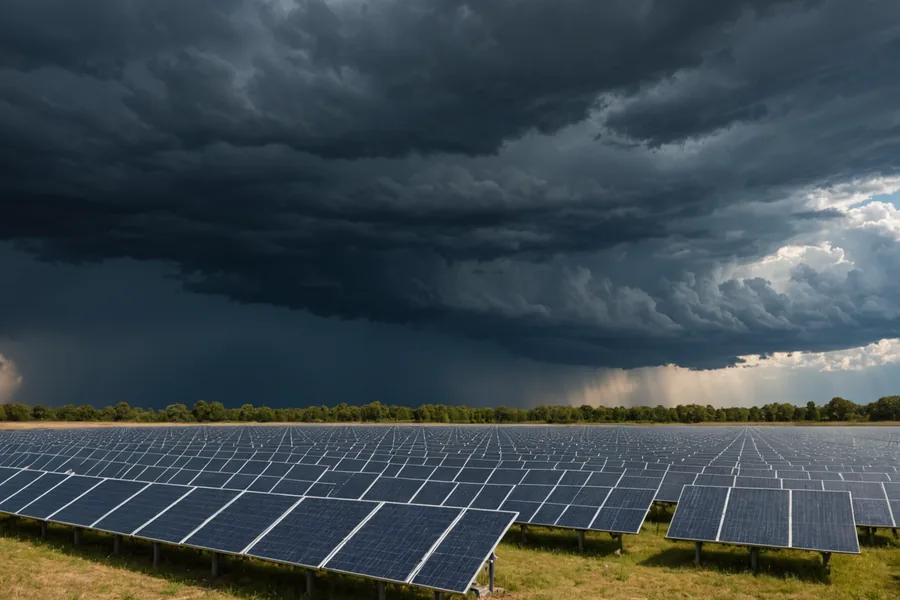
June 1st is the official start of the Atlantic hurricane season. For Southeast infrastructure operators — utility-scale solar farms, transmission assets, port facilities, and road networks — it is also a hard deadline. After June 1st, Riskwright cannot bind new parametric wind coverage for the current season. This article explains why the pre-season binding requirement is structural rather than administrative, how to design coverage for a specific asset, and what the full preparation timeline looks like for an operator starting from scratch.
Why June 1st Is a Hard Binding Deadline
Parametric insurance is structurally incompatible with adverse selection in the way traditional property insurance can sometimes be. When a named storm has formed and is tracking toward your region, the probability of wind threshold exceedance at your asset is no longer determined by historical base rates — it is substantially elevated by the observable near-term meteorology. At that point, any rational pricing for coverage against that event would require premiums that reflect the near-certain risk, which means the product is no longer economically viable for the buyer.
The operational rule is: parametric wind coverage must be bound before the coverage period begins, and it cannot be bound after a named storm enters a watch or warning area affecting the insured asset's region. In practice, given the lead time our underwriting process requires, this means the effective binding window for June 1 season start is mid-May at the latest. An operation that contacts us on May 30 cannot receive coverage for the current season.
For Gulf Coast assets, where tropical activity can begin in early June, the urgency is highest. For Southeast Atlantic Coast assets where the peak exposure typically runs August through October, there is somewhat more lead time — but we still recommend binding before June 1 to avoid timeline pressure.
The Preparation Timeline
The underwriting process from initial contact to bound policy typically takes 2–4 weeks for a standard single-asset infrastructure policy. For multi-asset portfolios or assets in areas with sparse ASOS station coverage that require additional analysis, 4–6 weeks is more realistic. Working backward from a May 31 binding deadline, this means:
Initial contact with the underwriting team should occur by late April at the latest for standard assets, or by early April for complex portfolios or locations requiring supplemental anemometer data evaluation. We recommend beginning the conversation in March to allow time for design iterations — choosing trigger type, threshold level, coverage window, and limit — before the spring deadline pressure arrives.
In practice, the binding deadline creates a concentrating effect: a substantial portion of the infrastructure inquiries we receive arrive in April and early May, which is when our underwriting team is at peak demand. Earlier engagement in the cycle produces better outcomes — more time for analysis, more opportunity for the client to review backtesting disclosures carefully, and no risk of deadline-driven shortcuts.
Coverage Window Design for Hurricane Exposure
The standard Atlantic hurricane season calendar runs June 1 through November 30, and most Gulf Coast and Southeast Atlantic Coast assets use this full window as their coverage period. But there are reasons to consider tailored windows for specific asset geographies.
Assets on the Gulf Coast of Alabama, Mississippi, and Louisiana typically experience their peak tropical exposure from August through October, when Gulf-origin systems are most frequent and the climatological storm track is most likely to produce significant wind events at those latitudes. A June 1 start date covers early-season activity but adds premium for months with relatively low historical tropical activity. Some Gulf Coast operators choose a July 1 or August 1 start date to balance coverage completeness against premium efficiency.
Southeast Atlantic Coast assets — particularly in Georgia and the Carolinas — are most exposed to recurving North Atlantic systems and Gulf-origin systems tracking northeast through the Florida Straits. Historical track data shows peak exposure for these assets in mid-August through mid-October. A window start of August 1 provides coverage for the statistically significant portion of the season at a lower premium than the full June–November window.
We provide historical storm track exceedance frequency analysis for the asset's latitude band as part of the coverage window consultation — showing the historical rate of threshold wind speed events by calendar month. This gives infrastructure risk managers the data to make an explicit tradeoff between coverage period length and premium cost.
Station Selection and Backup Protocols
Hurricane wind trigger design requires additional resilience in station specification compared to standard wind event policies. The primary concern: NOAA ASOS stations are located at airports, and airports near a hurricane landfall zone may lose power or suffer instrument damage during the storm passage. A policy that references a station that went offline during the trigger event creates a settlement ambiguity that neither party wants.
Every Riskwright hurricane-season parametric policy includes a primary/backup station protocol. The primary ASOS station is the designated trigger reference for normal operations. A backup ASOS station — typically the second-nearest airport station within 30–40 miles — is designated as the automatic substitute when the primary station's data is flagged as missing or quality-compromised for the trigger determination period. The backup station designation and the substitution trigger conditions are specified in the policy contract at binding, not determined after the fact.
In the South Carolina solar farm scenario described in our wind trigger article — a 150 MW facility that experienced a trigger event in September 2023 — the backup station protocol was specified but not invoked. The primary ASOS station maintained operation through the storm passage. Had it not, the backup station data would have been used automatically under the contract terms without requiring any additional negotiation.
How Parametric Wind Coverage Stacks with Traditional Property Insurance
We're not suggesting that parametric wind coverage replaces traditional property insurance for infrastructure assets. They serve fundamentally different purposes and are most effective when used together. Traditional property insurance covers assessed physical damage from the storm — replacement of damaged panels, structural repairs, business interruption — with a payment calibrated to actual damage over a timeline of weeks to months.
Parametric wind coverage provides immediate cash flow when the wind threshold is crossed, which arrives within 72 hours of trigger confirmation. This rapid payment covers emergency mobilization costs — inspection crews, tie-down hardware, debris clearance, repair contractor staging deposits — that must be committed before the traditional property insurer's assessment is complete. In a widespread storm event affecting many assets across a region, contractor availability is competitive. Operations with immediate cash in hand are positioned to mobilize faster than those waiting for property claim processing.
The optimal combined structure uses parametric coverage to fill the response mobilization gap (immediate but fixed amount) and traditional property insurance to cover the total assessed damage (larger, proportional, but slower). Sizing the parametric limit to the specific emergency response cost requirement — rather than the total potential loss — maximizes premium efficiency across the combined coverage program.