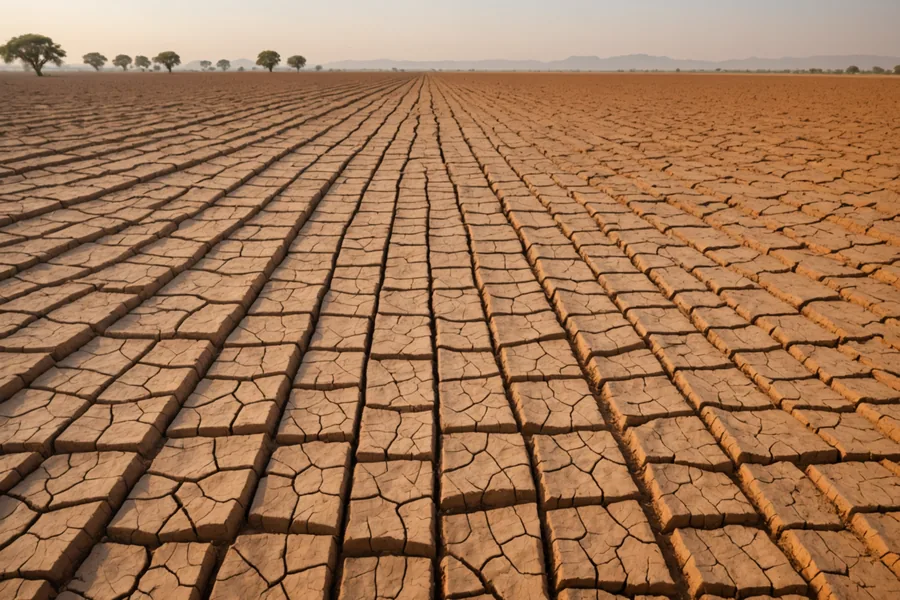
The 2024 growing season across the Southeast US produced one of the more significant SPI-3 anomalies in the Piedmont agricultural corridor's recent record. This post documents what the data showed through the growing season, which sub-regions were most severely affected, how trigger events played out in the field, and what the 2024 pattern suggests for coverage design going into the next cycle.
How the 2024 Drought Developed
The 2024 drought followed a pattern that is recognizable in the Southeast's paleoclimate and instrumental records: a combination of winter precipitation deficit reducing soil moisture recharge, followed by a dry spring that prevented recovery before heat-driven evapotranspiration demand escalated in May. By the time corn operations in southwest Georgia were approaching the V10 stage in late June, subsoil moisture reserves were already well below normal across much of the region.
The critical inflection point came in July. July 2024 precipitation across the Tift County / Cook County corridor in South Georgia fell to roughly 35–40% of the historical monthly median, based on NOAA Co-op station data. Combined with the deficit already accumulated from January through June, this produced 3-month SPI-3 accumulations falling below -1.5 at multiple stations by late July. The pattern was not an isolated July dry spell — it was the culmination of six months of below-normal inputs into the soil moisture system.
The spatial footprint of severe drought extended across three primary sub-regions in our portfolio coverage area. The Tift County / Cook County corridor in South Georgia saw the most severe readings, with SPI-3 reaching as low as -2.4 at peak. The Anson County / Union County area in western North Carolina showed SPI-3 values reaching -2.1 at the most affected reference stations. The Edgefield / Saluda County area in South Carolina showed SPI-3 reaching -1.9. These are not outlier readings — SPI-3 below -2.0 corresponds roughly to the 2nd historical percentile, conditions that recur perhaps once per generation at any given location.
The SPI-3 Spatial Pattern: Why Some Areas Were Spared
Not all of the Southeast experienced severe drought in 2024. The coastal plain of Georgia and eastern South Carolina received near-normal to above-normal precipitation through June and July, benefiting from Gulf moisture circulation that was cut off from the interior Piedmont. The Savannah River basin corridor also showed SPI-3 values in the -0.5 to -0.8 range — below normal but not approaching trigger thresholds for standard coverage structures.
This spatial heterogeneity is exactly the reason station selection matters so much in parametric policy design. An operation in Laurens County, South Carolina — which had a relatively normal season — would not have triggered on a policy referencing a station in the Edgefield corridor 45 miles away. The policy trigger follows the reference station's data, not regional drought narratives. Operations that experienced genuine loss but whose reference station was outside the drought footprint faced classic downside basis risk.
In our portfolio, five operations that reported significant yield losses in 2024 did not trigger — their reference stations fell outside the core drought zone. This is a real and honest limitation of parametric coverage. These clients received detailed explanations of why the index did not trigger alongside the post-season backtesting review. Three of the five subsequently adjusted their station selection for 2025 renewal to better reflect the actual spatial distribution of drought risk for their specific locations.
Trigger Event Timeline: From Data to Wire
For policies with standard SPI-3 below -1.5 trigger thresholds and coverage windows running through end of August or September, trigger confirmation occurred across affected stations between August 7 and August 22, as NCEI's monthly data products were processed and published. The variation in confirmation dates across stations reflects NOAA's processing pipeline timing, not any difference in when the drought occurred.
All triggered policies in the portfolio received settlement data packages and wire transfers within 72 hours of their respective trigger confirmation dates. The earliest wires arrived on August 9 for the first confirmed triggers. By September 1, all 2024 growing season triggers in the portfolio had been settled. For comparison, USDA RMA reported that a significant portion of 2024 agricultural insurance claims in Southeast states were still in adjuster pipeline as of December 2024.
What 2024 Means for Coverage Design Going Forward
Consecutive drought years — 2023 also produced below-normal precipitation across much of the same corridor — have two specific implications for coverage design in the following season. The first is soil moisture carryover. Entering a season with significantly depleted subsoil moisture means that even normal spring precipitation may not fully recharge the water table before summer heat demand begins. The effective drought threshold for crop stress may be reached earlier and with a smaller precipitation deficit than in a year with normal carryover.
The second implication is historical percentile recalibration. When two consecutive severe drought years are added to a 40-year historical record, the distribution of 3-month SPI accumulations shifts modestly — the most extreme decile becomes slightly less extreme as measured against the expanded record. For operations where the trigger threshold was calibrated to the 7th historical percentile, the actual threshold value in SPI-3 units may shift by 0.05–0.1 points after recalibration. This is a routine adjustment at renewal; we notify clients when recalibration affects their trigger percentile by more than half a percentile point.
For operations in the Piedmont corridor specifically, we recommended considering earlier coverage window start dates for 2025 — March rather than April — to capture the spring soil moisture recharge deficit that has been a consistent precursor to severe summer drought in both 2023 and 2024. A March through August window adds two months of precursor monitoring at a modest premium increment. Several clients in our portfolio made this adjustment for the 2025 season based on the 2024 data review.
A Note on the Sequential Drought Signal
We're not suggesting that consecutive drought years are evidence of a permanent shift in the Southeast's precipitation regime — two years is not a statistically meaningful trend in a system with this much natural variability. The NOAA 30-year climatological normals updated in 2020 reflect the 1991–2020 reference period, which included both wet and dry cycles across the region. The appropriate response to consecutive drought years is to review coverage window timing and station proximity — not to assume the historical percentile distribution has fundamentally shifted. We will assess whether the 2024–2025 pattern appears in the next climatological normal update when it publishes in the early 2030s.